
Analysis of Far-Right Violence Extremism – January 2026

Observatorio de atentados yihadistas – Enero 2026
12/02/2026
Operaciones contra el yihadismo en España 2026
18/02/2026
 Download the full report here
Introduction
In January 2026, the global landscape was marked by an alarming presence of terrorism and extremism linked to extreme right-wing ideologies. This analysis underscores the paramount significance of this issue in the contemporary world order.
Terrorism and extremism, irrespective of their ideological roots, have long posed a grave threat to international peace and security. Recent times, however, have witnessed a distinct shift in this threat landscape. The ascent of extreme right-wing terrorism has introduced a new layer of complexity to the global security equation.
This report aims to provide a comprehensive analysis of extreme right-wing extremism in January 2026, offering insights into its evolution and current manifestations. By dissecting the trends, causative factors, and ramifications of this phenomenon, our objective is to foster awareness, inform policymaking, and spur international collaboration to counter this growing menace.
AUSTRALIA
Man charged after displaying Nazi symbols at Australian beach
A 36-year-old man has been charged in New South Wales after allegedly displaying Nazi-related hate symbols in public at Bar Beach in Newcastle on Christmas Eve. A resident noticed the man’s tattoos, which included white supremacist imagery and symbols associated with the Nazi SS, and reported the incident to authorities after photographing them and providing a statement to police. The man was later arrested at a home south of Coffs Harbour (1).
Police charged him with knowingly displaying a prohibited Nazi symbol in a public place without a valid excuse, under laws introduced to curb the public use of extremist imagery. He was granted strict conditional bail and is scheduled to appear before Newcastle Local Court. The incident comes amid broader efforts by Australian authorities to respond to antisemitism and extremist hate symbols in public spaces.
Australia moves to deport British man over alleged neo-Nazi links
Australian authorities have cancelled the visa of a British national living in Western Australia on character grounds due to alleged ties to the neo-Nazi National Socialist Network. The man was taken into immigration detention and now has the option to appeal the decision or leave the country voluntarily. The government said the action reflects a zero-tolerance approach toward extremism, hate, and antisemitism.
The case is part of a broader crackdown on far-right extremism and hate symbols in Australia, where recent legal reforms introduced tougher penalties for Nazi gestures and imagery (2). Several foreign nationals linked to extremist activity have had their visas revoked in recent months, as authorities respond to growing concerns about antisemitism and violent extremist rhetoric. New measures also aim to strengthen powers to refuse or cancel visas for individuals who promote hate, division, or radicalisation.
Man charged after alleged neo-Nazi comments at Sydney anti-immigration rally
A man has been charged after allegedly making statements aligned with neo-Nazi ideology during an anti-immigration march in Sydney. Police said the comments, delivered over a loudspeaker to the crowd, included rhetoric associated with white supremacist and extremist beliefs (3). Authorities intervened at the scene and later charged the individual with using a carriage service to menace, harass, or offend.
The incident has raised concerns about the presence and visibility of extremist narratives within some protest spaces, particularly those focused on immigration. Officials and community groups warned that the use of neo-Nazi language and symbolism reflects broader challenges related to the spread of far-right ideology and the risk of radicalization within public demonstrations.
SPAIN
Atomwaffen Division sought to establish an operational cell in Spain
An investigation has revealed attempts by the US-origin neo-Nazi group Atomwaffen Division (AWD) to create a presence in Spain and move from online activity to potential violent action. Members operating under pseudonyms in private forums and Telegram channels discussed forming a Spanish branch, shared extremist propaganda, and circulated instructions for making homemade weapons and explosives. Some participants claimed to be based in Barcelona and expressed intentions to carry out attacks against perceived enemies (4).
The Spanish network appeared to consist mainly of young individuals connected virtually across several regions, including Catalonia, Valencia, Granada, and Zaragoza, and linked to broader far-right extremist circles and public demonstrations. Although no attacks were ultimately carried out, the case highlights growing concern about transnational accelerationist groups that promote decentralized “lone actor” violence. Authorities and security experts warn that such loosely organized networks, often operating online and inspired by international extremist movements, represent a significant and difficult-to-detect threat in Europe.
UNITED STATES
Viral fraud claims about Somali day cares fuel backlash and misinformation
A viral video by right-wing YouTuber Nick Shirley alleging widespread fraud at Somali-run child care centers in Minnesota has drawn millions of views and intensified political and public scrutiny. In the footage, Shirley visits several locations that appear empty and suggests they are receiving public funds without providing services. However, state officials and independent reporting found that many of the centers were operating normally, and investigations had not uncovered evidence supporting the specific fraud claims made in the video.
The controversy has had significant real-world consequences, including increased harassment and threats against Somali-owned businesses and broader political actions such as funding freezes and heightened federal enforcement. Community leaders and advocates warn that the video’s framing has contributed to stigmatization and collective blame against Somali Americans, amplifying misinformation and racial tensions while broader, more complex issues around fraud in public programs continue to be investigated separately (5).
Concerns raised over normalization of white supremacist rhetoric in US politics
Civil rights groups and extremism researchers have warned that language and narratives associated with white supremacist and far-right ideologies are increasingly appearing in political discourse linked to the Trump administration and its allies. Analysts point to the use of terms and themes related to demographic replacement, cultural threat, and anti-immigrant fear that echo concepts long promoted by extremist movements, even when not explicitly framed as such (6).
Experts caution that the mainstreaming of such rhetoric can legitimize fringe ideologies, shift public debate toward more exclusionary positions, and create an environment in which extremist narratives gain broader acceptance. Advocacy organizations argue that this normalization risks fueling polarization and discrimination, while supporters counter that the language reflects policy concerns about immigration and national identity rather than extremist intent.
White House criticized over rhetoric echoing white supremacist narratives on Greenland
The White House has faced criticism after some analysts and civil rights groups saw statements and messaging related to Greenland as echoing themes associated with white supremacist and ethnonationalist ideology. Commentators argued that the framing around strategic control, territorial expansion, and demographic or cultural protection resembled narratives historically used by extremist movements to justify ideas of racial or civilizational dominance.
Critics warned that such rhetoric, even when presented within a geopolitical or security context, risks normalizing language that overlaps with extremist worldviews and could be interpreted as legitimizing exclusionary or racialized thinking (7). Supporters, however, have defended the position as a strategic and economic discussion about Arctic interests, highlighting the broader political debate over the boundaries between national security discourse and the unintended amplification of extremist narratives.
Trump labor post sparks backlash over phrase linked to Nazi slogan
A social media post from a labor-related account associated with the Trump administration drew criticism after it used a phrase historically linked to a Nazi slogan. Critics, including historians and civil rights organizations, said the wording closely echoed language used in Nazi propaganda and warned that its use risked normalizing extremist symbolism, whether intentional or not (8).
Administration supporters and officials argued that the message was meant to promote work and economic values and denied any extremist intent.
Tensions rise in Minneapolis as a right-wing influencer’s appearance draws protests
A planned appearance by a right-wing social media influencer in Minneapolis triggered heightened tensions as counter-protesters gathered to oppose the event. Local authorities increased police presence to prevent clashes between supporters and demonstrators, amid concerns about public safety and the potential for confrontation. The situation reflects growing polarization around online political figures whose content has drawn both strong support and significant criticism. Community leaders and organizers expressed concern that such events can inflame divisions and amplify misinformation or inflammatory rhetoric (9).
Ten arrested in Tennessee over alleged white supremacist plot targeting infrastructure
US authorities arrested ten individuals in Tennessee accused of belonging to a white supremacist group that allegedly sought to form a paramilitary unit and carry out attacks against what they described as “high-value targets.” According to investigators, the group had discussed targeting critical infrastructure and other locations while organizing training, recruitment, and operational planning consistent with violent extremist intent. Civil rights organizations welcomed the arrests, warning that the case illustrates the ongoing threat posed by organized white supremacist networks attempting to move from online radicalization to coordinated violent action (10).
UNITED KINGDOM
Teen in UK planned attacks to create white supremacist ‘utopia’, court hears
A teenage boy from Leeds has admitted planning terrorist acts motivated by extreme white supremacist ideology, intending to help create a racially segregated “white utopia.” The court heard that he had researched targets, collected extremist propaganda, and expressed admiration for previous far-right attackers. His online activity showed deep immersion in violent accelerationist content and extremist communities (11).
Prosecutors said the case reflects the growing risk of online radicalisation among minors, with the teenager acting largely alone but heavily influenced by digital extremist networks. Counter-terrorism officials warned that the ease of access to violent propaganda and the normalization of lone-actor violence within far-right ecosystems continue to pose a significant security challenge in the UK.
Neo-Nazi network investigated over preparations for ‘race war’ in Britain
UK counter-extremism investigators have uncovered a growing neo-Nazi network that is actively preparing for violent racial conflict through physical training, recruitment, and propaganda activities. The group, linked to the “Active Club” movement, promotes white supremacist ideology and encourages members to prepare for societal collapse and racial confrontation by building physical strength, combat skills, and tight-knit local cells. Authorities and watchdog organisations warn that the movement’s decentralized structure and emphasis on fitness culture make it harder to detect and disrupt.
The network has reportedly expanded across multiple regions in Britain, using online platforms and encrypted messaging to recruit and coordinate while also spreading antisemitic and racist messaging offline through stickers and community intimidation tactics. Security experts say the model reflects a broader international trend among accelerationist far-right groups that seek to inspire lone actors or small cells rather than large hierarchical organisations, increasing the risk of future violence and complicating law enforcement efforts (12).
UK far-right activist attended Russian nationalist conference
Mark Collett, a prominent UK far-right figure and former leader within the British National Party youth wing, was reported to have attended a nationalist conference in Russia alongside other European extremists and ultranationalist actors (13). The event brought together participants from various countries to promote ethnonationalist ideas, oppose liberal democracy, and discuss international cooperation among far-right movements.
Security experts and counter-extremism groups have raised concerns that such international connections may help amplify propaganda, facilitate networking, and increase the legitimacy of fringe movements within their domestic contexts. Collett, who runs an online platform promoting white nationalist content, has a significant digital following, and his participation highlights the growing role of online influencers in spreading extremist narratives and connecting local audiences to a broader global far-right ecosystem.
GERMANY
White supremacist dating site breach exposes thousands of users
The pseudonymous hacker, who goes by Martha Root — dressed as Pink Ranger from the Power Rangers — deleted the servers of WhiteDate, WhiteChild, and WhiteDeal in real time at the end of a talk at the annual Chaos Communication Congress in Hamburg, Germany. WhiteDate, described as a “Tinder for Nazis,” WhiteChild, a site that claimed to match white supremacists’ sperm and egg donors, and WhiteDeal, a sort-of Taskrabbit-esque labor marketplace for racists, are all offline (14).
It exposed thousands of user profiles from WhiteDate, a dating platform created specifically for white supremacists. The leaked information reportedly includes usernames, email addresses, profile details, and other personal data, raising significant privacy and security concerns for those registered on the site.
Beyond privacy implications for users, analysts note that such leaks can provide valuable insight into the size, geographic distribution, and networking patterns of extremist communities operating online.
FRANCE
France bans entry to far-right activists over security concerns
French authorities have barred ten far-right activists from entering the country, citing risks to public order and national security. The decision was taken ahead of a planned extremist gathering, with officials arguing that the individuals were linked to ultranationalist and white supremacist networks and could contribute to tensions, hate speech, or potential violence.
The move reflects France’s increasingly proactive approach to preventing the cross-border coordination of extremist groups, particularly those connected to transnational far-right movements. Interior Ministry officials emphasized that the ban aims to curb the spread of radical ideologies and prevent international networking that could strengthen extremist mobilization within Europe (15).
ARGENTINA
Plans for a whites-only community in Argentina raise alarm
A far-right group has proposed creating a residential community in Argentina exclusively for white people, promoting the initiative through social media and extremist networks. The project is framed by its promoters as a space to preserve “European heritage” and racial identity, using rhetoric commonly associated with white supremacist and ethnonationalist movements. Authorities and civil society organisations have expressed concern about the discriminatory nature of the proposal and its potential links to extremist ideology (16).
Experts warn that the initiative reflects a broader trend of far-right actors attempting to move beyond online propaganda toward physical spaces that reinforce segregationist and exclusionary worldviews. While the project’s feasibility remains uncertain, the case has sparked public debate in Argentina about racism, hate speech, and the growing visibility of extremist narratives in the region.
PORTUGAL
Portuguese police arrest dozens in crackdown on ultra-right militant network
Portuguese police arrested 37 people suspected of belonging to an ultra-right militant group accused of promoting violent extremist ideology and preparing for potential acts of violence (17). Authorities said the network operated both online and offline, spreading neo-Nazi propaganda, recruiting members, and organizing paramilitary-style training activities. Weapons, ammunition, and extremist materials were reportedly seized during coordinated raids across multiple locations.
Officials described the operation as one of the largest actions against far-right extremism in Portugal in recent years, highlighting growing concern about the organization and militarization of small extremist cells. Investigators warned that such groups, often loosely structured but ideologically connected to transnational neo-Nazi movements, pose an increasing security risk due to their focus on radicalization, operational preparation, and potential for violent action.
Graphical Analysis of Far-Right Terrorism in January 2026
 In January 2026, the number of incidents linked to terrorism and right-wing extremist violence increased compared to December, with 17 recorded events worldwide. While this rise suggests renewed operational activity at the start of the year, the overall geographical distribution continues to follow the established pattern observed in previous months, with incidents concentrated in a limited group of countries where these ideologies maintain a sustained presence.
Rather than signaling diffusion, January points to a dynamic but stable threat landscape: fluctuations in volume occur, but within the same ideological ecosystems shaped by polarization, anti-immigration narratives, and digitally mediated radicalization. The continued recurrence of these countries highlights the persistence of entrenched networks and narratives that remain resilient to short-term disruption.
Overall, January confirms that right-wing extremist violence remains embedded in long-term socio-political dynamics, reinforcing the importance of sustained prevention, monitoring of online ecosystems, and structural responses that address polarization and normalization processes rather than short-term reactive measures.
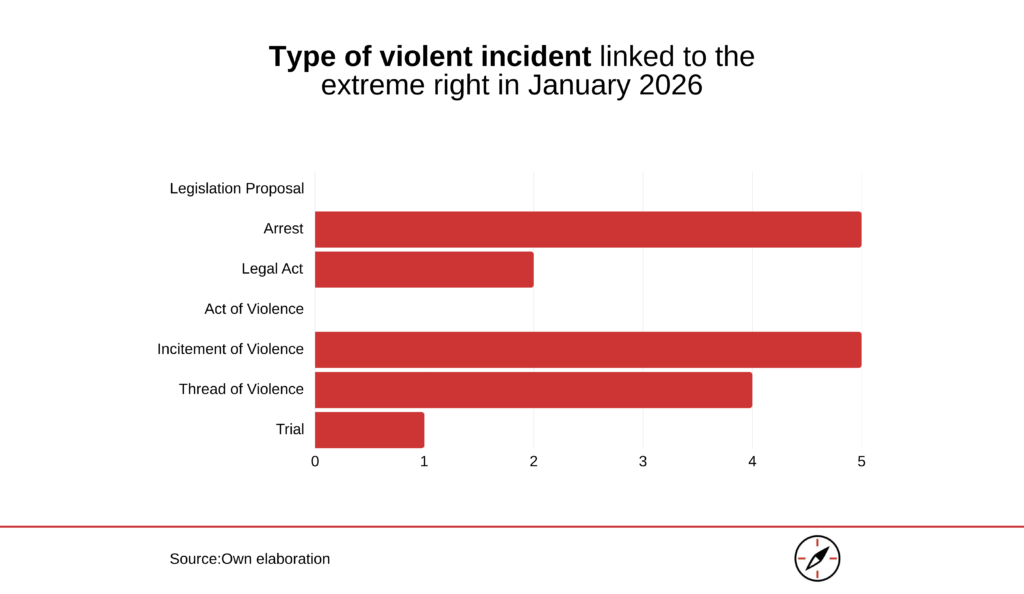 In January 2026, incitement to violence and arrests emerged as the most frequent types of incidents linked to extreme-right activity, with 5 cases each. This marks a shift from December, where threats of violence were the dominant category, and suggests a period characterized by both intensified extremist messaging and a parallel increase in law enforcement intervention.
The January distribution points to a dual dynamic: on the one hand, the prominence of incitement highlights the continued importance of pre-violent communication spaces, particularly online environments where radical narratives are disseminated and normalized. On the other hand, the high number of arrests suggests heightened operational activity by security services, aimed at disrupting networks and preventing escalation.
Overall, the data do not indicate a surge in completed acts of violence, but rather a landscape shaped by preparatory behaviors, ideological mobilization, and institutional response. January, therefore, reinforces the importance of sustained monitoring of incitement and threat environments, alongside long-term prevention strategies that address radicalization processes before they translate into physical violence.
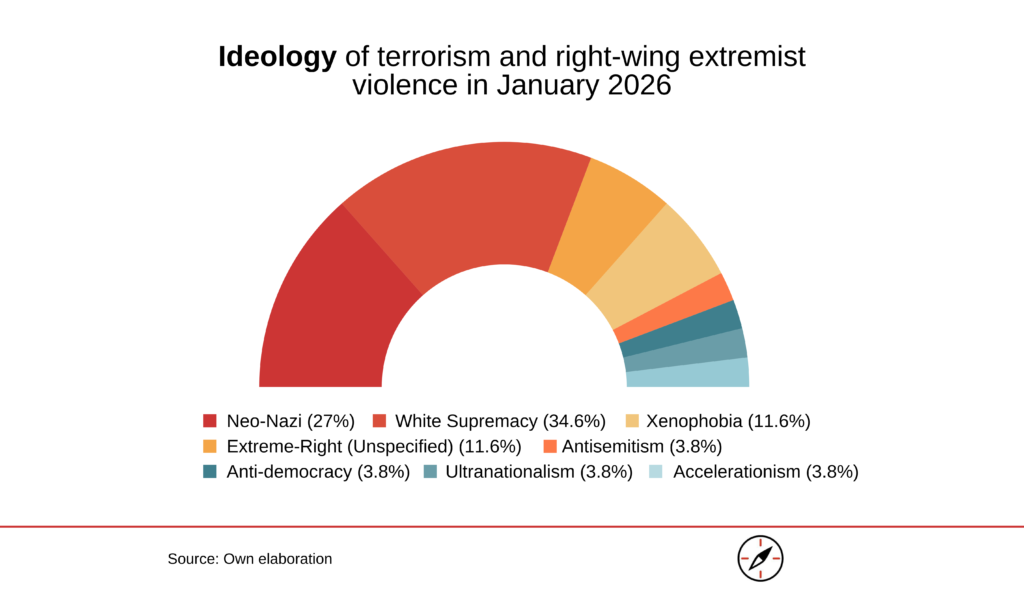 In January 2026, the ideological profile of terrorism and right-wing extremist violence continued to be dominated by White Supremacy and Neo-Nazi ideology, which together accounted for over 60% of all recorded incidents. While their combined share is slightly lower than in December, these frameworks remain the core reference points within the extreme-right threat landscape, confirming the continued centrality of historically entrenched and explicitly exclusionary worldviews.
Rather than indicating a weakening of core extremist doctrines, this pattern points to a hybridization of narratives, in which classical neo-Nazi and white supremacist frameworks coexist with more diffuse forms of exclusionary and anti-system rhetoric. Such diversification reflects the influence of digital ecosystems, where ideological boundaries are fluid and different strands of extremism reinforce one another through shared themes such as demographic threat, institutional distrust, and civilizational conflict.
Overall, January confirms both continuity and adaptation: while neo-Nazi and white supremacist ideologies remain structurally dominant, the presence of multiple secondary narratives highlights a threat environment that is increasingly flexible, networked, and capable of mobilizing across a wider spectrum of radical frames. This underscores the need for prevention approaches that address not only explicit extremist identities but also the broader ecosystem of narratives that facilitate normalization and radicalization.
REFERENCES
- BBC News, Lam, Australia to deport british man,
https://www.bbc.com/news/articles/cgez1drnzxdo - CAIR, CAIR welcomes arrest of Tennessee white supremacists who sought to form paramilitary unit,
https://www.cair.com/press_releases/cair-welcomes-arrest-of-tenn-white-supremacists-who-sought-to-form-paramilitary-unit-to-take-out-high-value-targets/ - CNBC, Breuninger, Trump labor post sparks backlash over Nazi slogan reference,
https://www.cnbc.com/2026/01/16/trump-labor-nazi-slogan-social-media.html - elDiario.es, elDiario.es, Atomwaffen Division, el grupo neonazi que pretendía instalarse para pasar a la acción en España,
https://www.eldiario.es/catalunya/atomwaffen-division-grupo-neonazi-pretendia-instalarse-pasar-accion-espana_1_12869109.html - KSTP News, Cooper, Tensions rise in Minneapolis as right-wing influencer faces counter-protest,
https://kstp.com/kstp-news/top-news/tensions-rise-in-minneapolis-as-right-wing-influencer-faces-counter-protest/ - La Prensa Libre AR, Cordoba, Planean comunidad exclusiva para blancos en Argentina,
https://laprensalibrear.com/news/2026/jan/07/planean-comunidad-exclusiva-para-blancos-en-ar/ - Reuters, France bans entry to 10 far-right activists,
https://es-us.noticias.yahoo.com/francia-proh%C3%ADbe-entrada-10-activistas-124248397.html - Reuters, Portuguese police arrest 37 suspected ultra-right militants,
https://www.reuters.com/world/portuguese-police-arrest-37-suspected-ultra-right-militants-2026-01-20/ - SC Media, SC Staff, White supremacist dating site breached, thousands of user profiles leaked,
https://www.scworld.com/brief/white-supremacist-dating-site-whitedate-breached-thousands-of-user-profiles-leaked - The Guardian, Brown, Boy planning terrorist acts wanted white supremacist utopia, Leeds court told,
https://www.theguardian.com/uk-news/2026/jan/13/boy-planning-terrorist-acts-wanted-white-supremacist-utopia-leeds-court-told - The Guardian, Kelly, Man charged with displaying Nazi hate symbol after showing off tattoos at NSW beach,
https://www.theguardian.com/australia-news/2025/dec/28/man-charged-with-displaying-nazi-hate-symbol-after-showing-off-tattoos-at-nsw-beach-ntwnfb - The Guardian, Makuch, Trump administration criticized over use of language linked to white supremacist rhetoric,
https://www.theguardian.com/us-news/2026/jan/14/trump-administration-white-supremacist-language - The Guardian, McLeod, Man charged after allegedly making comments aligned with neo-Nazi ideology at Sydney anti-immigration march,
https://www.theguardian.com/australia-news/2026/jan/26/man-charged-after-allegedly-making-comments-aligned-with-neo-nazi-ideology-at-sydney-anti-immigration-march-ntwnfb - The Guardian, Quinn, Leading UK far-right activist attends Russian nationalist event,
https://www.theguardian.com/world/2026/jan/04/leading-uk-far-right-activist-russian-nationalist-event-mark-collett - The Intercept, Valdez, Nick Shirley’s videos spread false claims about Minnesota Somali day cares,
https://theintercept.com/2025/12/31/nick-shirley-videos-minnesota-somali-day-cares-fraud-claims/ - The Mirror (US), Jones, Casa Blanca acusada de retórica supremacista blanca en debate sobre Groenlandia,
https://www.es.themirror.com/noticias/casa-blanca-supremacista-blanco-groenlandia-1620697 - The Telegraph, Evans, Neo-Nazi group preparing for ‘race war’ in Britain,
https://www.telegraph.co.uk/news/2026/01/04/neo-nazi-group-preparing-race-war-in-britain/