
Analysis of Far-Right Violence Extremism – February 2026

La desarticulación de las organizaciones neonazis portuguesas “Grupo 1143” y Movimento Armilar Lusitano
18/03/2026Análisis de la actividad yihadista en el Sudeste Asiático – primer trimestre de 2026
02/04/2026
 Download the full report here
INTRODUCTION
In February 2026, the global landscape was marked by an alarming presence of terrorism and extremism linked to extreme right-wing ideologies. This analysis underscores the paramount significance of this issue in the contemporary world order.
Terrorism and extremism, irrespective of their ideological roots, have long posed a grave threat to international peace and security. Recent times, however, have witnessed a distinct shift in this threat landscape. The ascent of extreme right-wing terrorism has introduced a new layer of complexity to the global security equation.
This report aims to provide a comprehensive analysis of extreme right-wing extremism in February 2026, offering insights into its evolution and current manifestations. By dissecting the trends, causative factors, and ramifications of this phenomenon, our objective is to foster awareness and inform policymaking while fostering international collaboration to counter this growing menace.
CANADA
Neo-Nazi “Terrorgram” Leader Faces Sentencing in Ontario Terrorism Case
An Ontario man linked to a neo-Nazi extremist network is awaiting sentencing after pleading guilty to terrorism-related offences. Matthew Althorpe, from the Niagara Region, admitted to three terrorism charges after originally facing eight counts. Prosecutors say he was one of the leaders of “Terrorgram,” a network of Telegram channels that spread violent extremist propaganda and encouraged attacks against Jewish, Muslim, and Black communities.
According to court documents, Althorpe helped write manifestos and produce online content calling for violence and promoting extremist ideology. Authorities say material circulated through the network inspired several real-world attacks, including a 2022 shooting targeting the LGBTQ+ community in Slovakia and a 2024 stabbing at a mosque in Turkey (1). Prosecutors are seeking a 20-year prison sentence, while the defence has asked for 12 to 14 years, arguing that Althorpe has shown remorse and did not directly carry out an attack. Sentencing is scheduled for March 27
UNITED STATES
Founder of Punjabi Devils Motorcycle Club Pleads Guilty to Illegal Firearms Trafficking
Jashanpreet Singh, a 27-year-old from Lodi, California, and founder of the Stockton-based Punjabi Devils Motorcycle Club, pleaded guilty to unlawfully dealing firearms and possessing a machine gun. According to U.S. authorities, Singh attempted to sell several weapons to an undercover officer in June 2025, including a short-barreled rifle, three assault weapons, machine-gun conversion devices, and a revolver. A search of his residence uncovered additional illegal firearms, including a machine gun, a silencer, and high-capacity magazines (2).
Law enforcement also found explosive devices at the scene, including a grenade and what appeared to be a claymore-type mine, which were safely destroyed by a bomb squad. Singh initially faced state charges but failed to appear in court and attempted to flee to India in July 2025 before being arrested at San Francisco International Airport. He remains in federal custody and is scheduled to be sentenced on May 11, 2026, facing up to 15 years in prison and significant fines if given the maximum penalties.
Controversy at Northwestern After Far-Right Symbol Painted Over Trans Memorial
A controversy erupted at Northwestern University after a red Cross of Burgundy—a symbol historically linked to far-right movements—was painted on “The Rock,” a campus boulder traditionally used by students for messages and announcements. The symbol was painted over a memorial featuring the transgender pride flag honoring a trans student who had died the previous year, prompting concern among trans students and allies who felt the act could be interpreted as a threatening or anti-trans message.
Students reported the incident to university administrators, but Northwestern declined to remove the symbol, explaining that “The Rock” is a student-moderated space and the university only intervenes if content constitutes an immediate threat, explicit harassment, or vulgarity. While the student who painted the symbol claimed it was meant as a historical reference, experts noted that far-right groups often repurpose historical imagery to signal ideological positions. The decision not to intervene has sparked debate on campus about free expression and whether the university adequately protects marginalized students (3).
Neo-Nazi Sentenced to Maximum Prison Term for Antisemitic Threats
A North Carolina man linked to neo-Nazi ideology was sentenced to the maximum penalty of five years in federal prison for sending antisemitic threats to a Georgia state lawmaker and a rabbi (4). The threats targeted Georgia’s only Jewish member of the State House and the rabbi of Temple Beth Israel in Macon after they publicly supported the passage of Georgia House Bill 30, a law defining antisemitism in the state.
According to federal prosecutors, the defendant used electronic communications to send violent and hateful messages intended to intimidate the victims because of their Jewish identity and public advocacy. Authorities emphasized that such threats can have a serious impact on targeted communities and will be prosecuted as federal hate crimes. The case was investigated by federal and local law enforcement agencies, and the court imposed the statutory maximum sentence to reflect the severity of the offense.
Florida Teen Accused of Plotting Mass Shooting at Wimauma Church
A 14-year-old boy from Wimauma, Florida, was arrested after authorities said he planned a mass shooting targeting a local church. The investigation began in January 2026 when detectives looking into a separate case involving child exploitation traced online activity to the teenager’s home. During the inquiry, investigators discovered messages in an online extremist chatroom in which the teen allegedly discussed carrying out a shooting at a church (5).
When officers searched the home, they found several firearms—one reportedly unsecured—and electronic devices containing multiple explicit images involving the abuse of young children. Authorities also said the teenager had interacted with an online extremist community associated with violent neo-Nazi ideology. The minor now faces several charges, including making threats of mass violence and possession and transmission of child sexual abuse material, while prosecutors evaluate whether he could be charged as an adult.
Controversy After Elon Musk Shares Content Linked to White Supremacist Narratives
Elon Musk sparked controversy after sharing posts on his social media platform X that appeared to amplify content associated with white supremacist narratives. According to reports, Musk reposted or interacted with accounts and messages that referenced extremist ideas about race and demographic change, which critics say are commonly circulated in far-right online communities (6). The activity raised concerns among researchers and civil society groups monitoring extremist discourse on social media.
Observers noted that Musk’s engagement with such content may contribute to the wider spread and normalization of extremist rhetoric online, especially given his large global audience and influence. The situation has intensified debate over the responsibilities of major platform owners in moderating harmful content and the broader impact that high-profile figures can have on online ecosystems where extremist narratives circulate.
Trump Shares Racist AI-Generated Video Depicting the Obamas as Apes
A controversial video shared by Donald Trump on his social media platform Truth Social sparked criticism after it depicted former U.S. President Barack Obama and former First Lady Michelle Obama as apes. The 62-second AI-generated clip promoted conspiracy theories claiming the 2020 U.S. election was manipulated and included imagery common in far-right online propaganda. The final seconds of the video showed the Obamas portrayed as smiling apes, a racist trope historically used in white supremacist propaganda (7).
The video also presented Trump as a lion—“king of the jungle”—while political opponents appeared as other animals, incorporating internet meme imagery associated with extremist online communities. After public backlash, the post was removed from Trump’s Truth Social feed, and the White House claimed it had been reposted in error by a staff member. Critics argued the content reflects broader patterns of racialized messaging and conspiracy narratives that resonate with segments of far-right online movements.
Las Vegas Substation Attack Investigated as Possible Terrorism
U.S. authorities are investigating a suspected terrorism-related incident after a 23-year-old man from Albany, New York, crashed a rented car into a power substation in Boulder City, near Las Vegas. The suspect, Dawson Maloney, was found dead at the scene from a self-inflicted gunshot wound after driving through a secured gate at the facility. Investigators discovered multiple weapons in the vehicle, including two shotguns, an AR-style pistol, ammunition, flamethrower devices, and tools, while the suspect was wearing body armor.
The investigation intensified after officers searched the suspect’s nearby hotel room and found explosive materials and what police described as a “smorgasbord of radical literature.” According to Las Vegas Sheriff Kevin McMahill, the room contained books related to extremist ideology across a wide spectrum, including right- and left-wing extremism, environmental extremism, white supremacy, and anti-government ideology. Authorities say the mix of ideological materials highlights a growing trend of individuals drawing from multiple extremist narratives to develop their own radical worldview (8).
U.S. Senator Demands Investigation Into ICE Recruitment Practices
U.S. Senator Sheldon Whitehouse has demanded that the Department of Homeland Security provide detailed information about the recruitment tactics and hiring standards used by U.S. Immigration and Customs Enforcement (ICE). Whitehouse raised concerns that recent recruitment efforts may be allowing individuals with extremist backgrounds to join the agency and that hiring standards have been weakened as the government pushes to rapidly expand the ICE workforce.
The senator’s letter highlights reports that ICE recruitment advertisements included imagery, slogans, and even music associated with white-nationalist groups, raising alarms about the messaging used to attract applicants. Whitehouse also cited concerns about aggressive enforcement tactics by ICE agents and the deaths of two U.S. citizens in recent operations, arguing that the agency’s recruitment and training practices require greater transparency and oversight (9).
SWITZERLAND
Investigation Finds Hundreds of Nazi-Linked Accounts at Credit Suisse
A U.S. Senate investigation has revealed that around 890 bank accounts at Credit Suisse may have been linked to Nazi individuals and institutions during World War II, according to Senator Chuck Grassley. The accounts reportedly included those belonging to entities such as the German Foreign Office, an arms manufacturer, and organizations tied to the Nazi regime, including the SS. The findings emerged from an independent review led by former U.S. prosecutor Neil Barofsky, commissioned after UBS acquired Credit Suisse in 2023 (10).
The investigation suggests the bank’s connections to Nazi finances may have been more extensive than previously known, including possible transfers of assets seized from Jewish victims and links to postwar networks that helped Nazis flee Europe. Lawmakers are now pressing UBS for greater transparency and additional documents related to the bank’s historical activities. The probe could reignite debate about the adequacy of a $1.25 billion settlement reached in the late 1990s with Holocaust victims, as investigators continue examining previously undisclosed accounts.
AUSTRALIA
Christchurch Mosque Attacker Claims Mental Health Forced Him to Plead Guilty
Brenton Tarrant, the Australian white supremacist responsible for the 2019 Christchurch mosque attacks in New Zealand, told the Court of Appeal that his mental condition forced him to plead guilty to the charges against him. Tarrant killed 51 Muslim worshippers and injured dozens more in shootings at two mosques during Friday prayers, the deadliest terrorist attack in the country’s history. He had previously admitted to 51 counts of murder, 40 counts of attempted murder, and one terrorism charge, and in 2020 received a life sentence without the possibility of parole—the first such sentence ever imposed in New Zealand (11).
During an appeal hearing in Wellington, Tarrant argued that harsh prison conditions—including solitary confinement, limited contact with others, and restricted access to reading materials—seriously deteriorated his mental health and made him “irrational” at the time he entered his guilty plea. Prosecutors disputed the claim, stating that there is no evidence he suffered from severe mental illness and that he had other legal options, such as requesting a delay of the trial. The court is now reviewing whether his plea was voluntary; if accepted, the case could return to court for a full trial.
Australian Senator Condemned for Claiming There Are “No Good Muslims”
Australian far-right senator Pauline Hanson, leader of the anti-immigration One Nation party, faced widespread criticism after suggesting in a television interview that there are “no good Muslims” (12). Speaking on Sky News, Hanson argued that Islam itself was problematic and claimed the religion promotes hostility toward Western societies, while questioning whether moderate Muslims truly exist.
The comments sparked strong backlash from politicians, community leaders, and anti-discrimination officials, who warned that such rhetoric fuels prejudice and social division. Australia’s Race Discrimination Commissioner called for an apology and cautioned that statements portraying Muslims collectively as a threat could encourage hostility or violence. Critics across the political spectrum stressed that Muslim Australians contribute positively to society and condemned the remarks as harmful and divisive.
GERMANY
German Police Seize Thousands of Nazi Items in Major Anti-Extremism Operation
German police seized thousands of objects linked to Nazi symbolism during a large operation targeting suspected far-right extremist networks. The investigation focused on a shop allegedly selling extremist materials across several federal states. Authorities carried out searches in 11 properties across Lower Saxony, Thuringia, Baden-Württemberg, Mecklenburg-Western Pomerania, Saxony-Anhalt, and Switzerland, as part of a coordinated crackdown on the distribution of illegal extremist propaganda (13).
During the raids, officers confiscated thousands of items, including records, keychains, clothing, and stickers displaying swastikas, SS skulls, imperial eagles, and figurines of Adolf Hitler. Investigators also discovered brass knuckles and explosive devices not legally available on the market, and identified a building used as a meeting place by members of the far-right scene in Thuringia. The investigation centers on a 43-year-old suspect and five alleged collaborators, and authorities have issued an arrest warrant for the main suspect
German Court Suspends Classification of AfD as Right-Wing Extremist
A German administrative court in Cologne has issued a provisional ruling preventing the country’s domestic intelligence agency from officially classifying the far-right party Alternative for Germany (AfD) as a “right-wing extremist” organization. The classification, introduced in 2025 by the Federal Office for the Protection of the Constitution (BfV), would have allowed authorities to intensify surveillance of the party and potentially support legal efforts to ban it.
The court acknowledged that there are indications of positions that could conflict with Germany’s democratic order, particularly regarding rhetoric about immigration and the concept of “remigration.” However, it ruled that the evidence presented so far does not justify labeling the entire party as extremist. The decision is temporary while the broader case continues, but it provides political relief to AfD, currently a major opposition force and subject to a long-standing political “cordon sanitaire” by other parties (14).
GREECE
Nazi Execution Photos Sale Followed by Vandalism at Greek Memorial
The Greek government is seeking to obtain a set of rare photographs believed to depict the execution of 200 Greek political prisoners by Nazi forces on May 1, 1944, at the Kaisariani shooting range in Athens. The images recently surfaced after being offered for sale online by a collector of German military memorabilia (15).
Greek authorities are working with experts to verify the authenticity of the photos and are exploring legal options to acquire them for preservation in the country’s historical archives.
Shortly after the photographs were listed online, the memorial at the Kaisariani execution site was vandalized, with plaques bearing the victims’ names smashed. The incident has raised concerns about the resurgence of extremist sympathies and the disrespect shown toward historical memory. Officials and local authorities have condemned the act and emphasized the importance of protecting sites that commemorate victims of Nazi atrocities.
SPAIN
Real Madrid Expels Fan After Nazi Salute During Champions League Match
Real Madrid expelled a supporter after he was captured on television performing a Nazi salute in the stands at the Santiago Bernabéu before the Champions League playoff match against Benfica. Security staff quickly identified the individual in the supporters’ section known as the “Grada Fans” and removed him from the stadium shortly after the gesture appeared on the broadcast (16).
Following the incident, the club announced it had initiated disciplinary proceedings to permanently revoke the fan’s membership, reiterating its condemnation of gestures that promote hatred or violence. UEFA later fined Real Madrid €15,000 and issued a warning that part of the stadium could be closed if similar incidents occur again, highlighting the organization’s ongoing efforts to address discriminatory behavior in European football.
UNITED KINGDOM
UK Teen Convicted Over Neo-Nazi Group Membership and Terror Publications
A teenager from Northumberland, UK, was convicted of several terrorism offences after a trial at Leeds Crown Court revealed his involvement with the banned neo-Nazi group The Base (17). The jury found him guilty of membership in the extremist organization as well as possessing and sharing terrorist publications. However, jurors could not reach a verdict on a separate charge of preparing acts of terrorism, and prosecutors decided not to pursue a retrial on that count.
Investigators discovered extensive evidence of far-right radicalization, including weapons such as knives and a crossbow, extremist propaganda, and online activity across numerous messaging platforms. Authorities said the teenager had engaged with multiple extreme-right chat groups and had searched for potential targets such as synagogues. Counter-terrorism officials warned that the case highlights the growing risks posed by online radicalization among young people exposed to extremist content.
Graphical Analysis of Far-Right Terrorism in February 2026
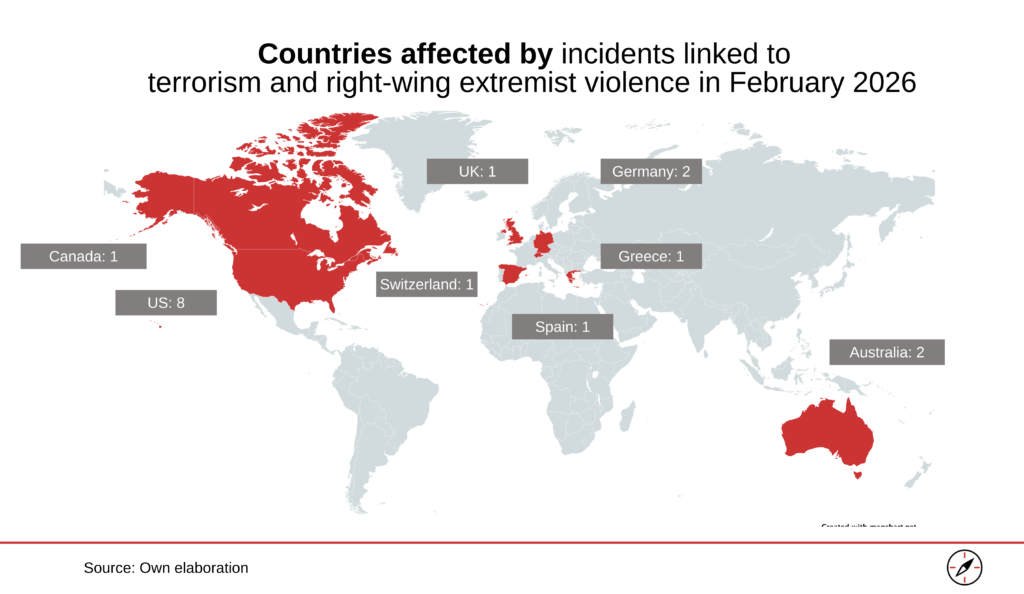 In February 2026, a total of 18 incidents linked to terrorism and right-wing extremist violence were recorded worldwide. Although the number of events slightly decreased compared to January, the geographical distribution of incidents remains largely consistent with the pattern observed in previous months, with cases concentrated in a relatively small group of Western democracies where these ideologies continue to circulate within established radical milieus.
The United States again registered the highest number of incidents (8), reaffirming its central position within the current landscape of right-wing extremist activity. This distribution highlights the persistence of activity across North America, Europe, and parts of the Anglosphere, reflecting environments where polarization, anti-government narratives, and anti-immigration rhetoric continue to interact with online radicalization dynamics.
Rather than indicating a geographic expansion of the threat, the February data suggests continuity within an already established ecosystem of radical actors and narratives. Month-to-month variations in incident numbers appear to reflect operational fluctuations rather than structural change. The recurrence of the same countries underscores the resilience of ideological networks and the role of digital spaces in sustaining mobilization.
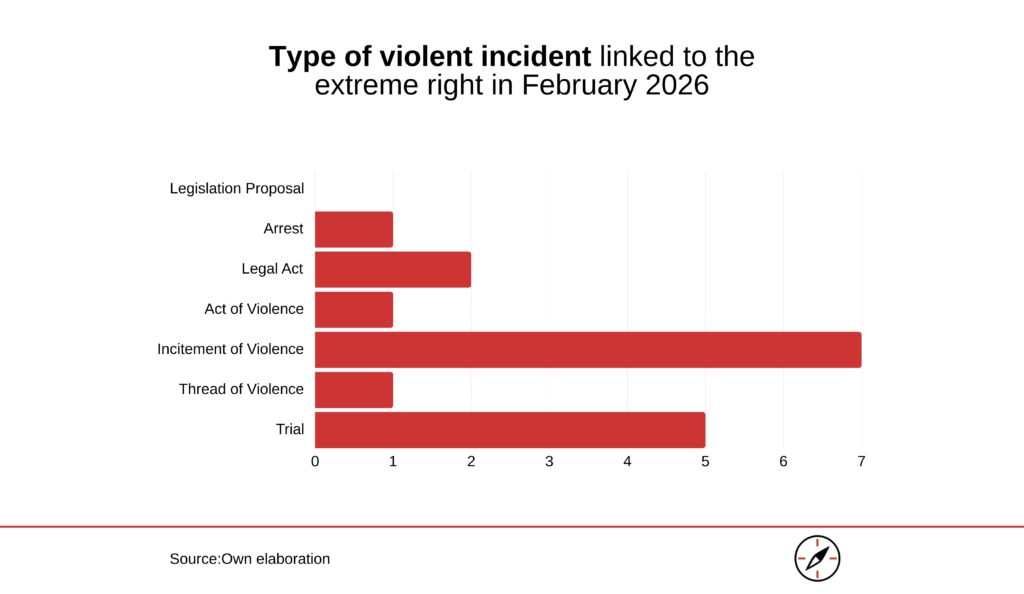 In February 2026, incitement to violence emerged as the most frequent type of incident linked to extreme-right activity, with 7 recorded cases, followed by trials (5). No cases linked to legislative proposals were recorded during the month.
The February distribution highlights the continued centrality of incitement within the ecosystem of extreme-right mobilization. The predominance of this category suggests that much of the activity remains concentrated in discursive and mobilizing spaces—particularly digital platforms—where extremist narratives are amplified, normalized, and used to encourage hostility or violence against perceived adversaries. At the same time, the relatively high number of trials indicates ongoing judicial processes related to previously detected extremist activity, reflecting the longer-term institutional response to radicalization and extremist offenses.
Overall, the data suggest a landscape dominated more by ideological propagation and judicial follow-up than by immediate physical violence. While isolated acts and threats persist, the February pattern reinforces the importance of monitoring incitement environments and addressing online radicalization processes, alongside maintaining judicial and preventive mechanisms that can intervene before extremist rhetoric translates into concrete acts of violence.
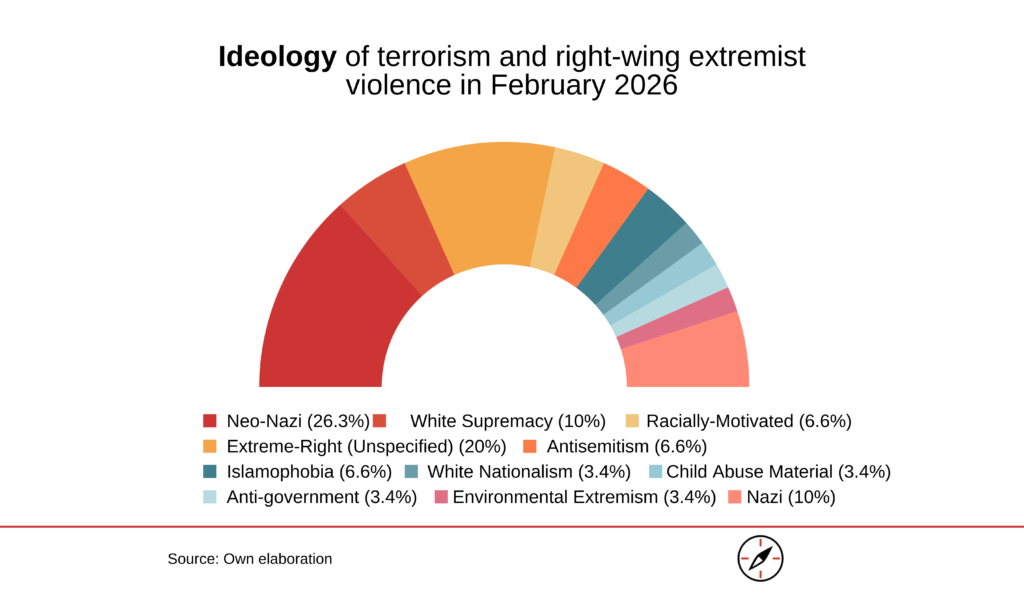 In February 2026, the ideological profile of terrorism and right-wing extremist violence continued to be strongly influenced by Neo-Nazi ideology and broader extreme-right narratives. When combined with related frameworks such as White Supremacy and Nazi symbolism or references, these ideologies remain the core pillars of the contemporary extreme-right threat landscape, confirming the continued relevance of historically entrenched exclusionary and supremacist worldviews.
However, the February data also illustrates a notable diversification of ideological frames. Although each of these categories represents a small proportion individually, their presence highlights the increasingly hybrid nature of extremist ecosystems, where actors draw on multiple grievance narratives that may extend beyond classical far-right ideological frameworks.
Rather than signaling fragmentation, this pattern reflects the adaptive capacity of contemporary extremist milieus, particularly within online environments where ideological boundaries are fluid and cross-pollination between narratives is common. While Neo-Nazi and white supremacist traditions remain structurally dominant, the emergence of additional narratives demonstrates that the extreme-right threat environment is increasingly networked, flexible, and capable of mobilizing across multiple grievance frames. This underscores the need for prevention and monitoring strategies that address not only explicit extremist ideologies but also the broader constellation of narratives and online ecosystems that facilitate radicalization and normalization processes.
REFERENCES
- BBC News. Harris. Teen guilty of belonging to banned neo-Nazi group. https://www.bbc.com/news/articles/c77k0yddpgjo
- Bitácora. Joya. El tirador de una mezquita de Nueva Zelanda dice al tribunal que su vitalidad mental lo obligó a declararse culpable. https://bitacora.com.uy/el-tirador-de-una-mezquita-de-nueva-zelanda-dice-al-tribunal-que-su-vitalidad-mental-lo-obligo-a-declararse-culpable/
- Democrata.es. Agencias. La policía alemana decomisa miles de artículos nazis en una macrooperación contra extremistas. https://www.democrata.es/internacional/la-policia-alemana-decomisa-miles-de-articulos-nazis-en-una-macrooperacion-contra-extremistas/
- El País. Bassets. Un tribunal alemán da aire a AfD al suspender su clasificación oficial como partido extremista de derechas. https://elpais.com/internacional/2026-02-26/un-tribunal-aleman-da-aire-a-afd-al-suspender-su-clasificacion-oficial-como-partido-extremista-de-derechas.html
- ESPN Deportes. EFE. Expulsan a aficionado por saludo nazi en el Real Madrid vs Benfica. https://espndeportes.espn.com/futbol/espana/nota/_/id/16359274/real-madrid-vs-benfica-nazi-saludo-aficionado-expulsan-champions
- FOX 13 News. Espy; Swanson. Teen accused of planning mass shooting at Wimauma church. https://www.fox13news.com/news/teen-accused-planning-mass-shooting-wimauma-church
- Global News. The Canadian Press. Ontario terrorism sentencing case. https://globalnews.ca/news/11645622/ont-terrorism-sentencing/
- Los Angeles Times. Vives. Las Vegas–Boulder City terror investigation. https://www.latimes.com/world-nation/story/2026-02-20/las-vegas-boulder-city-terror-investigation
- NBC News. Reuters. Credit Suisse Nazi-linked accounts investigated by UBS lawmaker Chuck Grassley. https://www.nbcnews.com/world/europe/credit-suisse-nazi-linked-accounts-ubs-lawmaker-chuck-grassley-rcna257207
- The Chosun Daily. Ji-han. Artículo sobre industria y extremismo. https://www.chosun.com/english/industry-en/2026/02/13/BKY25NIOC5H2ZIZQYFI4STVUQI/
- The Times of Israel. AFP. Australian right-wing lawmaker denounced for comments suggesting there are no good Muslims https://www.timesofisrael.com/liveblog_entr y/australian-right-wing-lawmaker-denounced-for-comments-suggesting-there-are-no-good-muslims/
- U.S. Attorney’s Office, Eastern District of California. U.S. Attorney’s Office. Founder of Punjabi Devils Motorcycle Club of Stockton pleads guilty to unlawfully dealing firearms. https://www.justice.gov/usao-edca/pr/founder-punjabi-devils-motorcycle-club-stockton-pleads-guilty-unlawfully-dealing?bm-verify=AAQAAAAM_____-wj4AS7jCz2doxXCeV4eOq9jimpiaLcEFnDO0ju9Xb446yzgMDEGv_XQhP6D4hxiSWMBGVYRr3BepiBLWxIlb3v08c3yD1TlySBfPqLSdRWz9D_PwGXAVXM9uTb9ttFOAWoYjcGku4eDBEDQpZCA04THjwgyIvqH3vUxcNVNhm_NsOXvfnCt-8K78Vgu774sDQG8lYapSvfv5xjnsHF7XJOduOsa-17fNLeQkG92KeLITP-rReZpCC0G0IuTa8_P2RL9xDEKBy0TyMHoiF0Gu6YKMdstD5bnSfRaRuhlySaVibR3u30j1p6AEBEPGz-AurHKyhnkDd7ej2BPycD2ImnKbpXHBysNNvRa3P2eSdMBGCPDzxwa-b6ZWYReCjbt4hqTQ
- U.S. Attorney’s Office, Middle District of Georgia. U.S. Attorney’s Office. Maximum sentence for neo-Nazi guilty of hate crime. https://www.justice.gov/usao-mdga/pr/maximum-sentence-neo-nazi-guilty-hate-crime
- U.S. Senate – Office of Senator Sheldon Whitehouse. Whitehouse, S. Whitehouse demands DHS produce information on disturbing recruitment tactics and diluted hiring standards for ICE agents. https://www.whitehouse.senate.gov/news/release/whitehouse-demands-dhs-produce-information-on-disturbing-recruitment-tactics-and-diluted-hiring-standards-for-ice-agents/
- WBEZ. Kurian, L. Trans students felt threatened by this symbol of the far right. Why didn’t Northwestern intervene? https://www.wbez.org/education/2026/02/04/trans-students-felt-threatened-by-this-symbol-of-the-far-right-why-didnt-northwestern-intervene
- World Socialist Web Site. Reed. Artículo sobre extremismo y política. https://www.wsws.org/es/articles/2026/02/09/c907-f09.html
- WRAL News. Becatoros. Greece will seek to obtain Nazi execution photos offered for sale online. https://www.wral.com/news/ap/a630c-greece-will-seek-to-obtain-nazi-execution-photos-offered-for-sale-online/